When the Ink Runs Dry: Navigating Burnout as a Tattoo (or any kind of) Artist
There is a unique kind of exhaustion that comes with being an artist, in any field. Whether you’re a writer, a painter, a glass blower, or you’re like me, a tattoo artist, sometimes you experience creative blocks. There’s no inspiration, no motivation, nothing that’s driving that passionate flame that screams “create” in the moment.
However, sometimes it can fester into something bigger than a moment. It’s more than being tired after a long week. A spark once fueled by every custom design, every consultation, and every session suddenly starts to feel dim. Ideas don’t flow as easily, and drawing begins to feel more like a chore instead of a hobby or a creative outlet.
There’s truth is, burnout is incredibly common in creative careers, especially in the tattoo industry. Yet, it’s rarely talked about openly. Many artists feel guilty admitting they’re struggling because tattooing is supposed to be their dream job — my dream job. But loving what you do doesn’t make you immune to becoming overwhelmed.
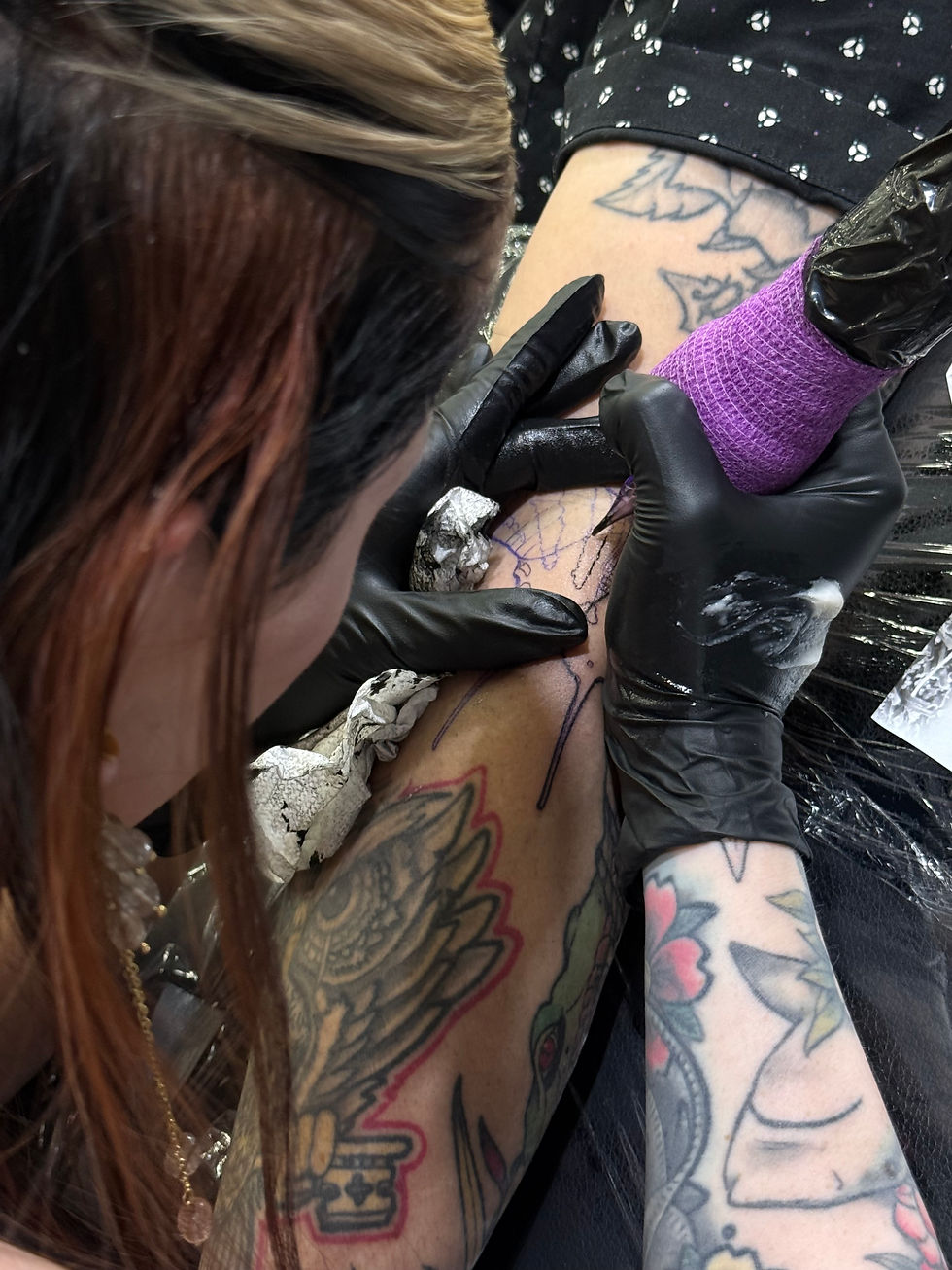
What Even Is Burnout?
Burnout is a state of physical, mental, and emotional exhaustion caused by prolonged stress. It often develops slowly over time rather than appearing overnight.
For tattoo artists, burnout can come from constantly balancing multiple responsibilities: creating artwork, managing appointments, answering messages, managing social media, educating clients, and sacrificing majority of your free time to do so.
On top of that, every tattoo carries permanent significance. Clients entrust you with something they want to wear for life. Oftentimes, the pressure of that alone can feel overwhelming to be…well, nothing short of literal perfection. That level of responsibility can become mentally draining, even if you do deeply care about your craft.
How Burnout Affects Creativity, and Why Tattoo Artists Are Especially Susceptible
In short, burnout makes every request feel a little heavier. Some artists begin doubting their abilities despite producing solid work. Others might spend hours obsessing over small details because nothing feels “good enough”. You lose track of your messages, you feel exhausted by the end of each day, you get quieter and quieter with every client that sits in your chair.
A tattoo artist isn’t just a person you found online or through your friend putting ink into skin. They also become:
An illustrator
A small business owner
A customer service professional
A marketer
A content creator
A therapist for clients
Even more frustratingly, they are also expected to be:
A mind reader
A negotiator (especially on pricing)
A magician
A printer
A personal answering machine 24/7
Someone who does not have a life outside of tattooing whatsoever
Someone who doesn’t have bills to pay
And don’t even get me started on the physical demand alone that tattooing takes.
Unlike many creative jobs, tattoo artists don’t have the luxury of creating only when inspiration strikes — creativity is performed on demand. Even more so, that creativity is directed towards appealing someone else’s vision, not your own. This in no way means that tattoo artists are not excited or ungrateful for each opportunity that is in our inbox. But it also does not mean that we are immune to the longing desire to feel that spark again.
Add the financial uncertainty, social media algorithms, a heavily oversaturated industry where you find yourself in comparison with hundreds of thousands of other artists, and an inconsistent work-life balance, it can be easy to see how burnout develops.
So…When Do You Realize?
Well, sometimes you don’t know you’re experiencing burnout until you do. And even if you do feel like you may be experiencing burnout, you might find yourself in a position where you’re gaslighting your own brain…like I did.
When I started tattooing, the creativity I experienced was alive and well. Though not new to the industry, I was new to the craft and beyond excited to see what this world had to offer me. It was challenging, but I couldn’t have been more grateful for the opportunity.
The second I opened my books as an apprentice, I was booked out for a month. Straight. For a newbie, the excitement was overwhelming, and the burnout wasn’t anywhere in sight. I was thrilled to have an opportunity to create and experience the world first hand.
Two years later, I found myself sitting in a therapy appointment two weeks ago with the therapist I’ve seen for over a decade. She asked me one simple question: “How’s work?” And my response was “It’s…okay.” Just okay. Not because I don’t love what I do, not because I’m not beyond grateful that this is what I get the chance to do for a living, that I was one of the small fish in a large sea of aspiring artists that actually made it. But I realized I wasn’t the tatt-er tot I used to be anymore.
I’ve stayed awake until three in the morning to render beautiful compositions only to be turned down. I’ve been ghosted on numerous occasions, including tattoos I started that I never got to finish without knowing why. I spend my free time booking clients and consulting with them over the phone only for them to disappear when deposits roll through. It sucks, but it’s a normal part of the gig.
I’ve also experienced clients getting hostile with me without cause. I’ve experienced, on more occasions than I’d like to count, sexual harassment by men to the point where we had to make a warning sign not to flirt with me. I’ve been degraded, sexualized, repetitively harassed through messages no matter how many times they were ignored, and humiliated by the disgusting comments that have been made to me. But, that’s a conversation we can have in another post.
Like I said, I’ve only been tattooing for two years. Never experiencing this before, ultimately I found myself hitting a breaking point. My body physically started shutting down. I stopped writing my blog posts because I just didn’t want to think about anything tattoo related anymore. I stopped drawing flash because I couldn’t think of anything to draw. I would come home and avoid my iPad for as long as humanly possible. I’d forget to message my clients back for days because in the moment, I just needed to not think about it. And I realized that I kept clocking out before I could even walk through the door. I just felt so, so tired. And I told myself that I didn’t deserve to feel tired.
I didn’t deserve to feel this way because I wasn’t experienced enough. I wasn’t good enough. I wasn’t booked out enough. I wasn’t doing enough to get to this point. There are so many artists out there who are bigger, better, busier, who are just doing all the right things, and I wasn’t. But that simply is not true. Everybody is different, and everyone experiences things differently, on different timelines. And I knew that my burnout wasn’t any less valid because of those things. With that being said, I also understood it wouldn’t be the last time I felt this way.

Navigating the Wave Without Drowning
It’s instinctual for many artists to push harder. Take more clients, post more content, draw more flash. Just do more than what you’re doing, because busier is better. Right? Wrong.
Recovery rarely comes from doing more. Sometimes, one of the hardest things to do is to give yourself permission to do less — at least for a moment.
Tip #1: Reevaluate Your Schedule. f you’re booked months in advance, it can feel impossible to slow down. But even the smallest adjustments matter. Whether it’s taking an extra hour to yourself in the mornings, specifying consult-only days, limiting large scale projects, whatever it takes. Protecting your energy isn’t laziness, it’s maintenance. And ultimately, your clients and workplace will thank you for that. For example, though my actual work time starts at 11am, I like to come in around 45 minutes to an hour earlier than my first appointment. It gives me time to get settled in, double check my designs fore the day, set up before my clients get there, grab a bite to eat, and chat with my coworkers before diving in. It’s a transition period that I have found is an absolute must to feel like my best self for the day.
Tip #2: Create Without Expectations. Not every drawing has to become a tattoo, and when you have to think that way every day, it’s really hard to not apply that elsewhere. Experimenting with mediums outside of tattooing can help bring you back to the basics and get the creativity flowing. Hell, even if you color with some crayons and practice your color theory, you never know how it can pay off to your career. Regardless, it provides a space where consequences in your creativity are low-impact and stress free. Play is often where recovery can thrive.
Tip #3: Separate Your Worth From Your Productivity
The tattoo industry is one of the most hardcore for celebrating the nonstop hustle. You’re a “great” tattoo artist if you’re constantly booked out, posting daily, taking walk-ins, and designing 24/7/. But the reality is, your value is not measured by how exhausted you are. It’s measured on the quality of work you can produce when you’re actually doing it. What’s the saying, quality over quantity, right? Rest is not something you earn after reaching a breaking point (despite what your childhood trauma teaches you). It is an essential part of sustaining a lifelong career.
Tip #4: Protect Your Inspiration. As someone who has grown up in the technologically booming era, I too am a victim of the endless doomscrolling, and find myself spending countless hours looking at other people’s work. It is great to look at other people’s work to think about how you can be improving on your own, but ultimately doesn’t end up inspiring you. Visit museums, read a book, listen to music, watch a movie. Photography, architecture, fashion, nature, and travel can influence your artistic voice in ways another tattoo page could never.
Tip #5: It’s Okay to Ask for Support
Tattooing can feel incredibly isolating at times. Many artists believe they have to figure everything out on their own. But talking to your coworkers, mentors, friends, or a mental health professional can make an enormous impact. Sometimes hearing another artist say, “I’ve been there too” can relieve the pressure of feeling like this isn’t a normal experience. Burnout isn’t a personal failure. It’s often a sign that you’ve just been carrying too much for too long. Don’t be afraid to ask for some time off when needed, take a reset, be open with your clients about how you’re feeling if you’re just not feeling it (I’ve been there, and it was one of the scariest moments of my life — and guess what, it didn’t backfire!). You can only produce your best work if you feel like your best self.
Your Creativity Isn’t Gone
The good news is that burnout does not completely erase your creativity, only obscures it. Think of it like a sun through heavy clouds. The light is still there, even if you can’t see it clearly today. Recovering from burnout isn’t about forcing inspiration to return. It’s about creating conditions where it has the room to come back naturally. No matter how big or small, each piece, each client deserves your best work — but you deserve to be the best version of you, too. The healthiest artists aren’t the ones who have never experienced it. They’re the ones who are capable of recognizing it, responding to it with compassion instead of guilt, and allowing themselves the space for it to create for decades instead of burning brightly for a few years.
Because your art matters. But so do you.


Well done.