What Hurts the Most? Tattoo Pain 101 and Relative Placement
As a tattoo artist, I’m asked on the daily if the placement my client chose is going to hurt. Usually I reply, “How honest do you want me to be?” — especially when I know that shit is going to suuuck. But honestly? That fear is completely valid. The pain is real, tattoos do in fact hurt, and anyone who tells you otherwise has nerves of steel or is straight up lying to you.
But coming from the artist herself: I hate getting tattooed. Yes, it’s ironic. Why do I hate it? I have the pain tolerance of a flower petal. But do I do it anyways? Obviously. Because I want to look just as cool as you all do!
Personally, I’ve had many tattoos that were a breeze; others had me staring at the ceiling, screaming silent prayers and debating how I even allowed myself to go through with every life choice I ever made. That said, pain is subjective. Everyone’s tolerance is different, which is why asking other tattoo fanatics usually will get you wildly mixed reviews. One person’s “easy” is considerably another person’s nightmare. So instead of relying on horror stories, let’s break down why certain areas hurt more than others, and build a generalized, relative pain scale that actually makes sense — not based on one person, but by someone who has worked in the industry for five years and has seen or done it all!
The Classic Tattoo Pain Chart (And Why It’s Only Half Right)
I’m sure you’ve all seen this image — the body diagram that looks like a thermal image rating tattoo pain by placement:
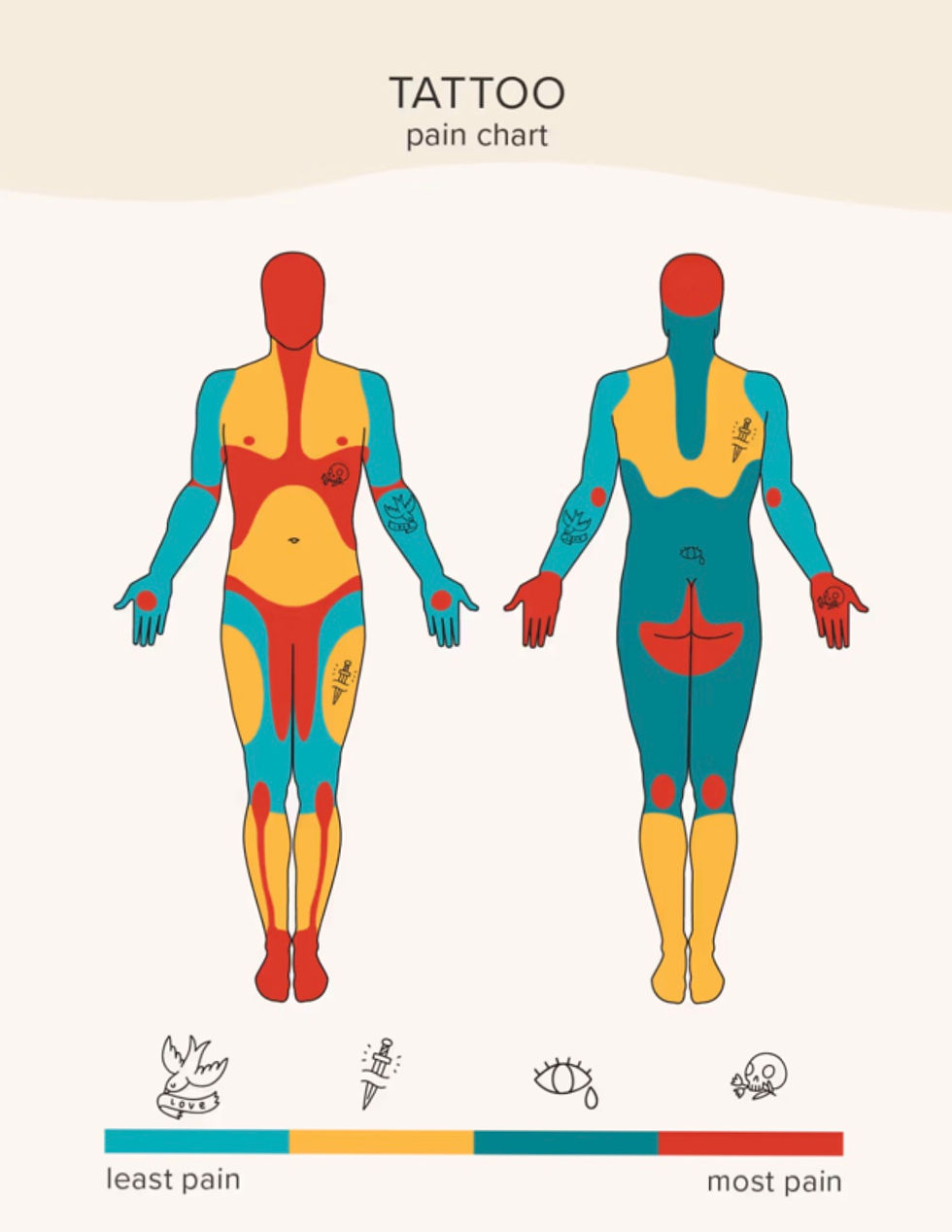
It’s not completely wrong, but it doesn’t exactly explain much. If anything, it often scares people away from certain placements without context. So let’s zoom out and look at what is actually happening under the skin.
Your Nervous System: The Real Reason Tattoos Hurt

This is the human nervous system. Your body contains over 7 trillion nerve fibers. If you laid them out end to end, they could stretch more than 100,000 miles — that’s enough to wrap around the Earth roughly four times.
So yes. Your body is actually sensitive. There is no such thing as a nerve-free zone.
But if nerves are everywhere, why do some spots hurt so much more than the others?
Breaking Down the Major Nerves
Your nervous system is organized into major branches, including:
12 pairs of cranial nerves connected to the brain
31 pairs of spinal nerves, broken down into:
8 cervical (neck, shoulders, arms)
12 thoracic (chest, ribs, abdomen)
5 lumbar (lower back, hips, legs)
5 sacral (pelvis)
1 coccygeal (tailbone)
Major nerve networks include:
Brachial plexus (arms and hands)
Lumbosacral plexus (lower body)
And some key individual nerves are:
Sciatic nerve (your largest nerve, running from lower back to foot)
Median nerve (forearm and hand)
Ulnar nerve (say hello to your “funny bone”)
Phrenic nerve (controls breathing)
When you overlay some of these nerves onto a pain chart, it can start to make a lot more sense. Areas with high nerve concentration and major nerve endings tend to hurt more.

While this photo isn’t perfectly scientific and this post does not in fact cover all the major science points, it is a much better reference than “red = bad”.
Pain Isn’t Just About Nerves
A few other factors include:
Skin thickness
Bone proximity
Movement
Healing difficulty
If you’ve ever noticed that some parts of your body are more ticklish or sensitive than others — you already understand the concept. If you can feel the difference in that, it’s a pretty good gauge to understand where you might tend to hurt more. Now let’s break things down into real-world terms.
NOTE: I have large, full color tattoos on nearly every part of my body, and I really do hate pain. These are my honest experiences, as well as what I’ve gathered from tattooing just about nearly every placement, or spending the last five years receiving feedback from other clients in the Studio.
A Relative Tattoo Pain Scale by Placement
The Arms The outer upper arm and outer forearm are some of the least painful spots to get tattooed, and are common starter placements for a reason.
The elbow, however, is a different story. The skin is thick, the bone is right there, and you’ll likely feel the needle rattling through that ulnar nerve. It’s also harder for ink to really stick here, which means more work for your artist.
Flip your arm over and things intensify:
Near the armpit: very sensitive, very spicy (god forbid the actual armpit…we call upon the tattoo gods for you to pull through)
Elbow ditch: thin skin, high swelling, sharp sting
Inner forearm: manageable, but more sensitive than the outer arm
Near the wrist: much sharper, more stingy
The Legs
Legs can be easy — or brutal — depending on placement:
Outer and side of thigh: thick skin, more cushion, generally easier
Inner and back of thigh: thin skin, much more sensitive, higher nerve concentration
Knee (front and back): very widely hated spot. Generally considered one of the worst. The healing process is horrific
Front: very bony and very thick skin
Back (“knee ditch”): sciatic nerve territory, not something to play with
Shin: bony and sharp, manageable but can hurt on longer session
Calf: mixed reviews, personally hated due to sciatic nerve but more cushiony than shin
Ankle and Achilles: back up on the pain scale, not fun at all
It’s important to also know on both the elbow and knee tend to be incredibly rough healing processes due to the amount of movement and scabbing, which also means they need more frequent touchups and it’s often expected to have to go back through.
The Feet
This is no joke of a placement.
Thin skin, tons of nerves, constant friction from socks and shoes; a tougher healing process overall. These placements are better suited for our experienced frequent flyers out there.
Fun fact: I once got a donut tattooed on the bottom pad of my big toe (which was affectionately dubbed my ‘toe-nut’, lol). It was absolutely painless, ironically, and lasted three months. Do with that information what you will. Though there is nothing left but a photo and lasting memory, it makes for an epic story.
The Hands and Fingers
Hands are reportedly hit or miss:
Top of the hand: tolerable for some, painful for others
Knuckles: definitely sharper
Fingertips and cuticle area: brutal
Longevity: poor - expect this area to need the most touch-ups. Some times it is not even worth it, and I don’t recommend this for any important/meaningful tattoos as you will have to pay for touch-ups on these spots.
And then there are palm tattoos.
Palms are widely considered of the absolute most painful tattoo placements, if not the most by many. They require heavy saturation, don’t last very long, and you will feel that pain crawl through every orifice of your body. These are strictly for seasoned collectors out there, and absolute masochists.
The Chest, Ribs and Abdomen
Across the board: rough.
Thin skin, bone, constant movement makes these areas challenging. Larger pieces typically require multiple sessions.
Ribs: mixed reviews, though surprisingly popular with first-timers for smaller tattoos
Stomach: awful, and for me personally an experience that had me fighting for my life
Chest and Sternum: very sharp, awful for larger pieces although they make for beautiful placements; tolerated by many for small pieces
The Back
Pain increases:
Closer to the spine
Closer to the lower back
Areas like the shoulder blade can be relatively easy, but full back pieces definitely require some stamina. It’s doable, but it isn’t a walk in the park. I typically salute the girlies that book those full spine pieces are their first tat. Shoutout, you crazy gals.
The Neck
The idea of a needle near your throat while trying to breathe normally creates significant anxiety and tension for some people that only amplifies a pretty sensitive area. This placement is definitely not beginner-friendly, and takes a long time to tattoo from thin skin and significant movement.
Behind the ear, however, is surprisingly manageable and one of my personal favorite spots pain-wise. The vibration takes some getting used to, but the nerve density is much lower than other placements.
The Head and Face
These areas have extremely thin skin, high nerve density, and bone directly underneath — which means the vibration travels fast and far.
Scalp: intense buzzing, rattles your skull, incredibly sharp
Face: sharp, uncomfortable, mentally taxing
Healing, fast, but the process itself is not for the faint of heart
These placements are usually reserved for our most heavily tattooed individuals who understand exactly what they’re signing up for.
Pain Is Temporary, Tattoos Are Forever
At the end of the day, unfortunately you just have to experience the pain for yourself to understand. Your tolerance, your mindset, your artist’s technique, and even how well you slept or hydrated the night before can all play a role.
No chart can tell you exactly how something will feel to your body, but understanding why certain areas hurt can help you make a more informed decision.
Now I never recommend to anybody avoiding their “dream” tattoo placement to avoid the pain, because the reality is you will regret that decision later. However, if you’re nervous about the process, start somewhere a little more forgiving. Build your tolerance, and trust your artist. And remember: every tattoo hurts a little — but that pain fades, and the art stays.
And if you’re still unsure?
Just ask your artist! Chances are, they’ve been there…literally.


I love the detail you went into explaining why the common charts seen, may not be accurate for everyone. I have had different pain experiences than those charts suggest. Very informative!
so awesome and informative!