Creative Labor Under Pressure: Applying Work-Life Balance Social Theory to Tattoo Artists
Work-life balance has long been a subject of concern within social science, labor studies, and public health, yet its relevance has grown increasingly urgent as modern work structures continue to evolve. What began as early critiques of rigid societal organization has since developed into a broader examination of how the workforce design impacts physical health, mental well-being, job satisfaction, and long-term career commitments. Today, we’re going to be examining from a social science perspective the developments of work-life balance research and apply its core findings to the tattoo industry.
Research on work life balance dates back to the late 50s, with one of the most notable studies from G. W. Pickering, an English physician and Professor of Medicine at Oxford University, titled “Disorders of Contemporary Society and Their Impact on Medicine.” While it doesn’t directly cite issues related to the current work-life balance conversation, he first opens the topic with his concerns of societal organization, which he addresses as a “…disease which may perhaps be named compulsory uniformity”(Pickering, 1955). However, the interest and further research of the topic took off under the publication of James O’Toole’s “Work and the Quality of Life: Resource Papers for Work In America” in 1974. The book serves as a curated collection of over a dozen resource papers prepared for the U.S. Secretary of Health, Education, and Welfare during the height of the Vietnam War to examine how the institution and organization of work impact the quality of life while identifying measurements of change through improved well-being and social justice from a holistic standpoint instead of job market measurements.
O’Toole compiled a basic list of assumptions made by the social science community regarding the state of the workforce in America, including the following:
“Some jobs are better than others, and no matter what is done all jobs can’t be made uniformly satisfying.”
“Almost all bad jobs can be improved, at least marginally.”
People differ widely in their psychological makeup and intelligence and hence have differing needs from their jobs.”
“Intelligence and psychological makeup are better criteria for job placement rather than race, sex, class or age.”
People with jobs that they don’t like are less committed to their jobs than people who like their work.”
It is better for the individual, the workplace, and society for workers to be committed to their jobs than for them to not be committed.”
At the time, this book challenged optimistic assumptions about the American “work ethic” by demonstrating how the current organizational design and social institutions shape workers lives. The collection highlights the measurable impacts of mental and physical health in poor job organization, reconstructs sociotechnical systems for productivity, focuses on a lack of education and training specific to women, middle managers and blue-collar workers during a time where these groups faced particularly distinct issues, and coordinated government organization strategies that included educational reform, economic measures, and more. In turn, it influenced debates about job redesign, vocational education, and federal workforce policies across the country (O’Toole et al., 1974).
Unlike many other traditional occupations, the nature of tattooing demands not only strong technical abilities but also creative expression, often leading to unique challenges that make achieving work-life balance more elusive in this industry. Additionally, the competitive and fast-paced nature of this industry, paired with significant pressure to meet client demands and maintain artistic integrity, can result in long hours and high levels of stress. The physically demanding nature of the work itself can also blur the boundaries between work and personal time, making it difficult for tattoo artists to disconnect and recharge outside of the studio. These factors, among many others, contribute to an industry-wide notion that tattoo artists are less like to achieve a satisfactory work-life balance compared to other professions.
Achieving a work life balance is crucial for several reasons. Maintaining balance allows individuals to prioritize their overall well-being, including physical, mental, and emotional health. It reduces the risk of burnout, stress-related illness, and mental health issues. A balanced lifestyle enhances productivity and performance both in and outside of the studio. More so, it allows not just artists but any individual to recharge and foster stronger creative flow. Striking this balance promote happiness, longevity, and a sense of fulfillment in one’s own lifestyle. There are several studies that signify the importance of an effective work-life balance. Even though fostering a healthy lifestyle outside of the workplace, work stress can significantly reduce employee performance. Work-life balance includes the balance of time and the balance of involvement, leading to commitment both to work and to life outside of
work. Increased workload can counterweight the balance between time and involvement to life outside of work, decreasing overall satisfaction and thus negatively impacting productions (Dwitanti et al., 2023).
A recent correctional study examined the role of work-life balance in the relationship between job stress and career satisfaction using survey measures that analyzed demographics, career satisfaction scales, work-family balance scales, and job stress scales:
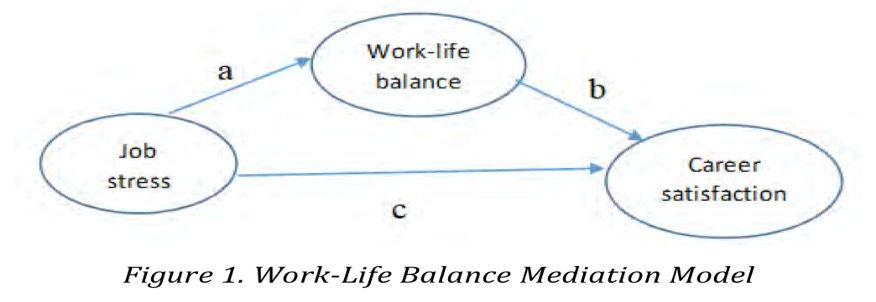
The above model represents the correlation between variables and their impact to the three main points of discussion. Job stress directly impacts work-life balance, which in turn impacts career satisfaction, while also negatively impacting career satisfaction directly. This study reported that although Relationship C (job stress in relation to career satisfaction) has a reportedly higher satisfaction due to overall job fulfillment and professional development, Relationship A (job stress is relation to work-life balance) plays a significant responsibility between Relationship B (work-life balance in relation to career satisfaction), which in turn deflects the impact and results of Relationship C (Cobanoglu et al., 2023).
Employee workload is critical to determining productivity and turnover. The main objective of workload management serves is to minimize workload imbalance within a company. Social Influence Theory, developed by Salonica and Pfeffer in 1977, believes that workers decide their job satisfaction by observing others on similar levels and inferring their satisfaction on the basis of observation. In other words, a worker unconsciously compares their input/output ratio to others within the same job level, noting discrepancies and unconsciously rating their satisfaction on perceived social agreement and overall satisfaction. This also includes the perception of workload and staff strength. When any company becomes understaffed or lacks a level of trained staff for certain roles and responsibilities, existing staff becomes overstretched with greater responsibility. This stimulates and employees’ perception of workload imbalance not just themselves but amongst others, which decreases employee satisfaction and develops negative organizational perceptions between management and other staff members (Inegbedion et al., 2020).
For a tattoo artist, this may appear as comparing the time spent in the industry to the current number of clientele, and comparing to similarly pathed artists. While this can be a complex comparison due to clientele demands of artistic interests and locations alone, tattoo artists can often find themselves unsatisfied in their work by comparing their own workload to others within the studio, which can be perceived as uneven distribution from management, lack of effort in advertisements or social media promotion form overhead, or dissatisfactory output that leads artists to question their position and success in the industry.
Addressing exactly how to achieve such a balance is complex across the board and overall, there is no actual consensus to the accepted definition of work-life balance. Generational differences, regions, countries, social values and familial customs all play a role in how this definition can vary from person to person. This can also look different to each worker based on their overall person, whether they are single parents, disabled workers, elder, et cetera. Regardless, achieving a healthy work-life balanced has gained increasing importance across the globe, particularly in the aftermath of the COVID-19 pandemic, which created a drastic shift to remote work and left hundreds of thousands unemployed. This shift brought on new challenges and increased persistent existing ones, including overworking, extended working hours, and blurred boundaries between work life and personal life (Sandoval-Reyes et al., 2021).
Finding this balance looks different for every industry. Many companies in Europe are experimenting with four day work weeks, increasing employee benefits, and changing employee structures from the inside out to increase productivity and work satisfaction. In fact, these companies have found success in their implementations thus far. A pilot program launched in Spain of Spring 2023 implemented a four-day workweek by scheduling local holidays on Mondays through the months of March and April, impacting 360,000 workers. Similarly, 73 various companies across the United Kingdom in 2022 conducted a similar work-week study, which all demonstrated significant statistical increase in improved business productivity, worker health, reduced stress and fatigue, and overall employee happiness (Bloom, 2023).
As a tattoo studio, our services are considered a luxury item that are often requested around others’ work schedules that are much less flexible than ours. These business, including ours, employ 1099 contractors that are technically only paid for the work they complete. Therefore, suggesting to pay employees for an “extra day” of work is considered nearly impossible for this industry in the sense of constructing a set work-week for tattoo artists that does not impact their pay. While financial realities and studio expectations still must be met, artists retain the ability to set limits around working hours, days off, and the volume of work accepted.
Taking control of work-life balance in the tattoo industry begins with recognizing that job satisfaction and career longevity are not solely determined by how much work is taken on, but by how sustainably that work is structured. Tattooing may be meaningful and creatively rewarding, but without boundaries, that fulfillment can quickly turn into burnout. Artists must therefore approach their schedules, booking practices and availability with the same care they bring to their craft. Establishing intentional schedules, protecting rest days, pacing physically demanding sessions and resisting constant social comparison within studios are practical ways for artists to regain balance. Then, artists can benefit from evaluating their careers based on sustainability, health, and personal fulfillment.
Ultimately, achieving a healthy work-life balance in tattooing is not about reducing ambition or sacrificing income; it is about redefining success to include well-being, creativity, and longevity. As the broader workforce continues to experiment with new work models that prioritize human functioning and basic needs, tattoo artists can apply these on an individual level by designing a career that supports both their art and their lives. In doing so, artists not only protect their own quality of life, but strengthen their commitment to their work, their studio, and the industry as a whole.
Sources:
Bloom, D. (2023). Four-day work week trial in Spain leads to healthier workers, less pollution.
World Economics Form. https://www.weforum.org/agenda/2023/10/surprising-benefits-
Çobanoğlu, F., Yıldırım, Ö., Seven, S., & Sertel, G. (2023). The mediating effect of work-life
balance in the relationship between Job Stress and career satisfaction. European Journal of Educational Management, 6(2), 83–99. https://doi.org/10.12973/eujem.6.2.83
Dwitanti, E., Murwani, F. D., & Siswanto, E. (2023). The effect of work-life balance on
employee performance through work stress and workload. International Journal of Business, Law, and Education, 4(2), 569–586. https://doi.org/10.56442/ijble.v4i2.211
Inegbedion, H., Inegbedion, E., Peter, A., & Harry, L. (2020). Perception of workload balance
and employee job satisfaction in work organisations. Heliyon, 6(1).
O’Toole, James. (1974). Work and the Quality of Life: Resource Papers for Work In America. The Massachusetts Institute of Technology Press.
Pickering, G. W. (1955). Disorders of Contemporary Society and Their Impact on Medicine. The Lancet, 266-6901(1149-1152). https://doi.org/10.1016/S0140-6736(55)92893-2.
Sandoval-Reyes, J., Idrovo-Carlier, S., & Duque-Oliva, E. J. (2021). Remote Work, Work Stress, and Work-Life during Pandemic Times: A Latin America Situation. International Journal of Environmental Research and Public Health, 18, Article 7069.


Comments